
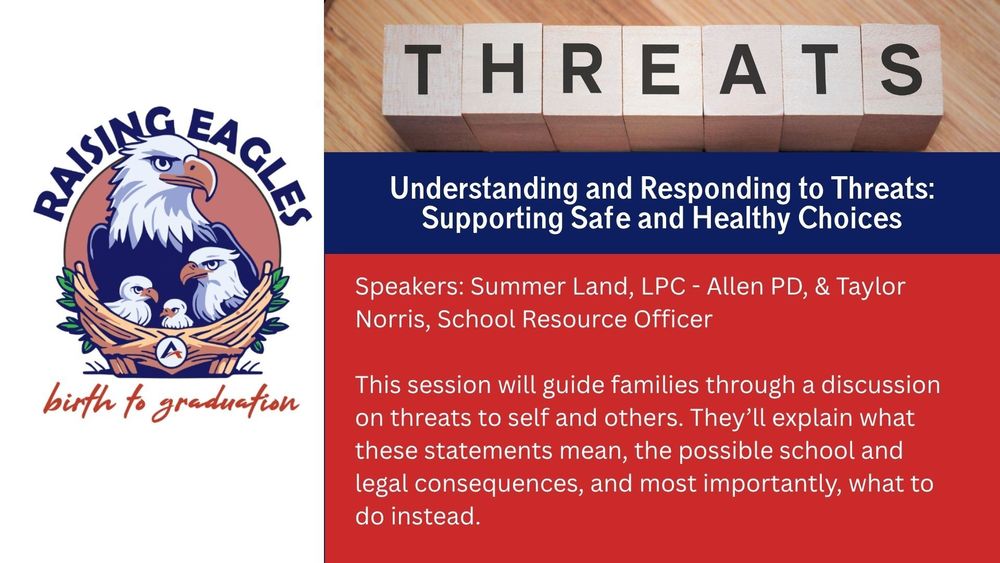
Raising Eagles: Understanding and Responding to Threats
Introduction
Today’s session focuses on understanding and responding to threats made by children and adolescents. Threats can be directed toward self or toward others, and when they occur, they often signal deeper emotional, psychological, or environmental struggles. Many families are unsure how to interpret these statements, what signs to watch for, or how to respond if their child or another child communicates an intent to harm themselves or someone else.
This training consolidates the key information shared by mental health and law enforcement professionals from Allen ISD and the Allen Police Department. The goal is to equip families with accurate knowledge, practical tools, and clear steps to take when threatened behavior arises. You will learn what warning signs matter, why impulsivity is a major factor in youth behavior, how law enforcement and schools respond, and what resources are available.
The information is organized into two major areas: threats toward self and threats toward others.
Section One: Understanding Threats Toward Self
Threats of self-harm or suicide often surface through words, drawings, writings, online posts, or sudden shifts in behavior. Children and teens do not always have the language to express distress, so their earliest warnings may emerge indirectly. The first skill caregivers must develop is the ability to recognize genuine warning signs and know what questions to ask.
Risk Factors for Suicide
- Prior suicide attempts
- Diagnosed or undiagnosed depression
- Substance use
- Family history of mental illness or suicide
- Family violence
- Exposure to peers who express suicidal thoughts
- Chronic medical problems
- Ages 15 to 24, or over age 60
- Chronic pain
- Impulse control challenges
- Adverse childhood experiences
- Unhealthy or abusive relationships
- Social isolation
- Cultural stigma surrounding mental health
The COVID lockdown years intensified many of these factors. Long periods of isolation disrupted social development, increased depression and anxiety, and made returning to normal school life difficult for many students. A number of youth became more comfortable avoiding social interaction, while others sharply felt the loss of connection.
Verbal Warning Signs
Statements such as “I want to die” or “I wish I wasn’t here” can never be dismissed as empty drama. Some children disguise their seriousness by framing these statements as jokes. Others express suicidal thoughts only when in trouble or overwhelmed. Regardless of presentation, every statement of self-harm must be treated as real until proven otherwise.
- Talking about wanting to die
- Expressing a desire to kill oneself
- Discussing plans or methods
- Verbalizing guilt, shame, or hopelessness
- Mentioning that others would be better off without them
Even indirect statements like “I wish I could disappear” may indicate deeper internal turmoil.
Behavioral Warning Signs
- Withdrawing from friends or activities
- Sleeping far more or far less
- Sudden changes in appetite
- Sharp emotional swings
- Cutting or self-injury
- Wrapping up unfinished tasks
- Giving away possessions
- Expressing last messages of love or gratitude on social media
- Writing goodbye notes or cleaning their room in an unusual, finalizing way
One of the most misunderstood behavioral signs is the sudden improvement in mood following deep depression. While families may interpret this as progress, professionals explain that this improvement sometimes occurs when a person has resolved to follow through with a suicidal plan. The relief of “decision” can briefly lift their emotional state.
Biological Factors
Mental health struggles can also have physical origins. During and after COVID, many hospitalized teens showed severe vitamin D deficiencies from lack of sunlight. Depression and anxiety are linked to measurable chemical imbalances, including lower serotonin levels in individuals with suicidal thoughts or attempts. Genetics and environment interact, making some youth more vulnerable.
Impulsivity and Attention-Seeking: Why Both Matter
A child’s brain does not finish developing until the mid-20s. The part responsible for impulse control develops last. As a result, many young people act before fully understanding consequences. An impulsive suicide attempt is still a suicide attempt, even if the youth claims afterward that they “didn’t mean it” or “just wanted attention.” Many near-fatal situations start with impulsive decisions coupled with little knowledge of the dangers of medications or methods.
How to Respond When a Child Expresses Suicidal Thoughts
What Not to Do
- Do not argue with the child’s feelings
- Do not deny or minimize the situation
- Do not say “You’ll feel better tomorrow”
- Do not shame or guilt them
- Do not say “Think about how sad your family will be”
- Do not make promises such as “I won’t tell anyone” or “You won’t have to go anywhere”
- Do not rush the conversation
What To Do
- Listen more than you talk
- Ask direct questions: “Are you thinking about killing yourself?”
- Stay calm and patient
- Acknowledge their pain
- Focus on what can be done right now
- Offer comfort when appropriate
- Gently explore what triggered the thoughts
- Discuss safety steps
- Be willing to bring in outside support
Direct questions do not plant ideas in a child’s mind. If the thoughts are present, they are already there. Direct questions simply uncover them.
Helping Children Support Their Friends
- If a friend expresses suicidal thoughts, they must tell an adult
- Keeping secrets in this context can cause harm
- A friend might be angry in the moment, but staying safe matters more
Children should never have to shoulder life-and-death responsibility alone.
Section Two: How Law Enforcement Responds to Threats Toward Self
When law enforcement receives a call regarding suicidal behavior, they gather as much information as possible:
- What was said
- How it was communicated
- Whether there is a plan
- Any past attempts
- Current mental health treatment
- Evidence such as texts or social media posts
Officers then determine the most appropriate next step. In most cases, parents willingly transport their child to a hospital for evaluation. If no parent is available, or if immediate safety requires it, officers may complete an APOW (Apprehension by Police Officer Without Warrant) and transport the individual for urgent assessment.
The goal is not punishment. The goal is safety.
If hospitalization is not immediately required, officers work with families on safety plans:
- Who will supervise the child
- How harmful items will be secured
- What appointments are scheduled
- What follow-up steps the school must take
Crisis counselors and school counselors receive updated information so they can monitor and support the student during the school day.
Section Three: Resources for Suicide Prevention
- 988 Suicide and Crisis Lifeline (call or text)
- LifePath Systems (Collin County community mental health)
- Starry Counseling (free counseling for children)
- Harold Murphy Counseling Center (Texas A&M Commerce clinic with sliding scale fees)
- Child and Family Guidance (counseling and psychiatric services on sliding scale)
- Crisis Text Line (text “HELLO” or “HELP” to speak with a trained responder)
In Allen ISD, high school student ID cards include crisis hotlines on the back for quick access.
Section Four: Understanding Threats Toward Others
Threats toward others include statements, posts, or actions that create fear or imply the intent to cause harm. These may occur verbally, in writing, online, or through photos or videos.
What Makes a Threat Credible
- Specificity
- Intent
- Method mentioned
- Target identified or implied
- Tone and context
- The receiver’s fear response
- History of similar behavior
- Supporting behavior (such as drawings or researching weapons)
Even if a youth claims they were joking, the impact on others and the potential risk remain real.
Why “It Was Just a Joke” Is Not a Defense
Many youth test boundaries online. A common example is the video shown in the presentation: an 18-year-old made a bomb threat in a group chat, claiming it was a joke. He faced up to 15 years in prison. This example highlights a crucial truth: intent does not erase impact. Law enforcement and social media platforms take violent statements seriously.
Common Charges for Threats Include:
- Harassment
- Making a terroristic threat
- Inducing panic
- False alarm
- Threatening mass violence
- Using electronic communications to threaten violence
All of these have appeared among students in recent years.
Many youth do not understand that fines, court costs, and long-term legal consequences fall on both the student and the parent.
In Texas, children as young as 10 can be charged with a crime.
Section Five: School Threat Assessments
Texas has significantly strengthened its school threat assessment systems. Schools now use a standardized statewide platform called Sentinel. For serious behavior, threat assessments follow students until age 25, ensuring that if they transfer districts, the receiving district has accurate safety information.
Allen Police Department conducts its own threat assessments based on an FBI-informed model. Additional county-level teams assist with cross-agency coordination. The goal is not only to identify danger but also to intervene early and redirect struggling students toward supportive solutions.
Section Six: Cyberbullying and David’s Law
David’s Law, passed in 2017, followed the suicide of a Texas teen who endured severe cyberbullying. The law requires schools to have policies for bullying and cyberbullying, and it expands schools’ authority when off-campus bullying affects on-campus life.
Key provisions include:
- Schools must notify parents within 24 hours when bullying is reported
- Law enforcement can subpoena information to identify anonymous cyberbullies
- Encouraging someone to commit suicide can be charged as a Class A misdemeanor
- Students can be charged for cyberbullying behavior that leads to harm
Phrases like “go kill yourself,” which many teens use casually, can lead to criminal charges.
Section Seven: Responding When You See or Hear a Threat Toward Others
- Prioritize Safety
If the threat is personal and immediate, remove yourself or your child from danger and call 911. - Stay Calm
A calm adult can think clearly and model steady behavior. - Ask Questions
If it is safe to do so, ask clarifying, open-ended questions:- “What does this mean?”
- “Tell me more about this message you posted.”
- “Why did you say this?”
- Save Evidence
Screenshots, messages, posts, and written materials are critical. Do not delete anything. - Report It Immediately
You can contact:- School administration
- School resource officers
- Local police
- Anonymous reporting systems such as the Say Something app
- National or federal agencies if appropriate
- Monitor Your Child’s Social Media
Access to your child’s accounts is not optional. If you pay for the device, you must maintain oversight. Children do not yet understand how permanent and far-reaching digital communication can be.
Section Eight: Resources for Threats Toward Others
- FBI threat reporting website
- Secret Service threat assessment materials
- National Center for School Safety
- Texas School Safety Center
- SchoolSafety.gov
Section Nine: Balancing Information and Mental Health
Parents sometimes worry that exposure to news stories about violence will harm their child. Professionals explain that context matters. You can protect your child while still preparing them for reality by:
- Asking how they feel when they see difficult news
- Listening more than explaining
- Adjusting details to be age-appropriate
- Using tough stories to reinforce why safety drills happen
- Helping them understand which parts of the world they can control
Children do not need every graphic detail, but they do need opportunities to process feelings and ask questions.
Ultimately, preparing children for adulthood requires gradually teaching them to navigate the real world while ensuring that home remains a safe space for conversation, reassurance, and guidance.
Conclusion
Understanding threats toward self and others requires awareness, patience, and active communication. Youth today face pressures, influences, and stressors that differ from those of past generations. They need adults who take their words seriously, listen without judgment, ask direct questions, and involve professional support when needed.
The consistent message from mental health and law enforcement professionals is clear: It is always better to report than to remain silent. It is always better to ask than to assume. And it is always better to intervene early than to risk tragedy.
By staying informed, staying engaged, and staying connected, families can create environments where children feel seen, supported, and safe.